Sports content has a rhythm that few other niches share. Traffic jumps on match day, spikes again when a transfer rumor breaks, and then fades until the next fixture. Athletics fans behave the same way around meets, record attempts and qualifying windows. For anyone who publishes in this space, or pays to be mentioned on a sports site, that rhythm creates a quiet industry trend: a growing number of results pages, score trackers and fan blogs are all competing for the same links, and not every one of them is worth your time.
This article looks at how a simple authority checker fits into that picture. It is based on what one dashboard that puts DA, DR and Trust Flow side by side says on its public pages, as read on 9 November 2026. I did not run paid comparisons against other tools, so I will not claim it beats anyone.
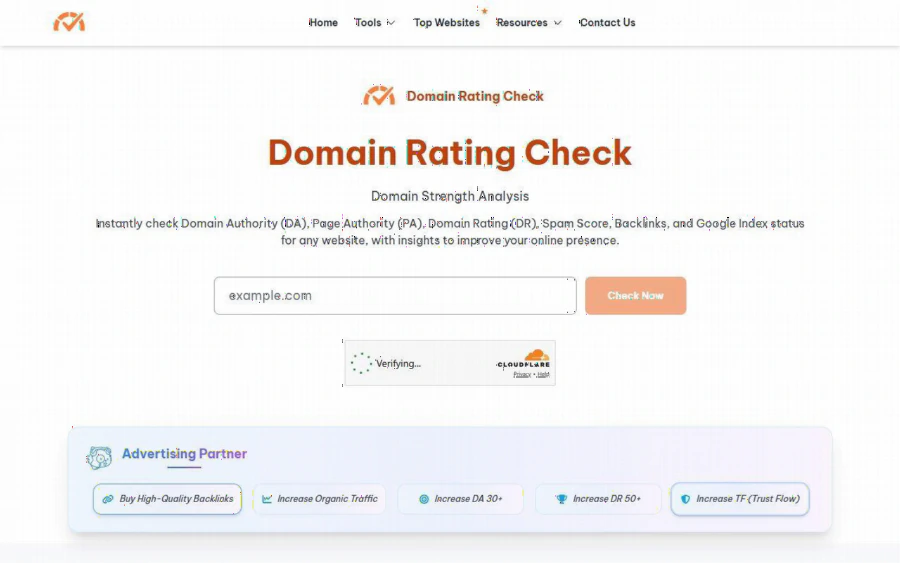
Domain Rating Check homepage with a domain box, a Check Now button and a list of metrics it covers
Why the sports niche makes authority checks harder
Most niches grow slowly. Sports sites tend to appear in waves. Around a major tournament or an athletics season, new results pages and commentary blogs launch quickly, some with real editorial teams and some that are mostly scraped tables with a thin layer of text. To a visitor they can look alike, and a site with a flashy design and a long list of fixtures can still have a weak or messy link profile.
That matters in two situations. If you run a small sports blog or a club site, you want to know which sites are realistic partners for a mention or a guest article. If you work in marketing for a sports retailer, a coaching service or a fitness app, you want to avoid spending a budget on a placement that adds nothing. In both cases the first filter is a quick look at a few authority numbers, not a deep audit.
A word of caution that applies to this niche in particular: sports pages are often surrounded by betting offers and sponsor banners. A link from a site like that is not automatically bad, but it is worth checking the spam signals before you decide. Nothing here is a reason to bet; it is simply a reason to look closely at where your brand name ends up.
What the checker covers
According to the homepage, you enter a domain, complete a Cloudflare verification step, press Check Now and wait a few seconds. The page says it returns Domain Authority (DA) and Page Authority (PA), Ahrefs Domain Rating (DR), Spam Score, backlinks, Google Index status, organic traffic, and Majestic metrics such as Trust Flow (TF) and Citation Flow (CF). A deeper analysis section lists topical trust flow, some social metrics and Majestic EDU and GOV data.
The glossary on the site gives rough guidance. It scores DA and PA from 1 to 100, describes a DA of 50 or more as strong for most industries, treats a DR of 70 or more as an authoritative site, and suggests keeping Spam Score below 30 percent. These are rules of thumb stated by the site itself, not universal standards, so treat them as a starting point.
There are also separate tool pages. The Ahrefs Domain Checker page focuses on DR, backlink profile and referring domains, and the Trust Flow Checker page covers TF and Citation Flow.
Ahrefs Domain Checker page on the same site, with a single domain box and a Check Now button
How to use it on a sports partner shortlist
Here is a plain workflow for a small team. The example is an illustration, not a real client: imagine a regional running club that wants to place one article on a sports results site before a spring track season.
1. List five to ten candidate sites. Include a mix of well-known and unknown names.
2. Run each domain through the checker and record DA, DR, Trust Flow and Spam Score in a simple sheet.
3. Look for big gaps. A site with a high DA but a very low Trust Flow, or a high Spam Score, deserves a manual look before you send an email.
4. Open the site yourself. Do the articles have bylines, dates and original reporting, or do they look copied?
5. Check how the site treats outbound links. A page with dozens of unrelated sponsored links is a weaker home for your mention.
6. Rank the survivors and contact the top two or three.
Doing this takes an afternoon rather than a week, and it creates a record you can reuse next season when the same questions come back.
Strengths worth noting
The first strength is breadth in one place. Many people check DA in one tool, DR in another and Trust Flow in a third. Here the three families of metrics sit behind one search box, which saves tabs and copy and paste.
The second is that the public pages explain the numbers. The glossary does not just show a score; it says what a score range roughly means, which helps beginners who are not sure whether a DR of 35 is good or bad for a local sports blog.
The third is simplicity. There is no long setup on the pages I read, only a domain field and a button.
Limits you should know about
Honesty matters more than hype, so here are the gaps I found.
The site does not say where its data comes from. Its glossary attributes DA to Moz, DR to Ahrefs and TF and CF to Majestic, but neither the homepage nor the About page explains how the figures are gathered or whether there is any partnership with those providers. That means you should treat the output as a screening aid, and confirm anything important in the original provider's own tool.
It also does not state pricing, usage caps or accuracy limits on the pages I read. If you plan to check dozens of domains a day, test it with a small batch first and see how it behaves.
The Cloudflare verification step appears before each check, which is fine for occasional use but can feel slow if you are working through a long list.
Finally, the pages show an Advertising Partner banner with offers such as buying backlinks and raising DA or DR. That is the site's own commercial layer. Authority numbers are useful, but chasing a number by purchasing links is a different matter, and no checker should push you in that direction.
Trust Flow Checker page that covers Majestic Trust Flow and Citation Flow
Who it suits and who should look elsewhere
It suits independent publishers, small clubs, coaches, sports retail marketers and freelance SEO people who need a fast first pass on a handful of domains. It is a good fit when you want to sanity check a site before replying to an offer or before sending a pitch.
It is not the best fit for agencies that need historical charts, large exports, automated reports or contractual data guarantees. Those users will want the full original platforms and a clear service agreement.
Getting started in five minutes
Open the homepage and type a domain you already know well, for example your own club or blog. Compare the numbers with what you expect. If they look plausible, run two or three competitors, then the sites on your shortlist. Save the results with the date, because authority scores shift over time and a screenshot from last month can mislead you.
Sports will keep producing new sites every season. The teams that benefit are the ones that decide early which numbers they care about, check them quickly, and spend their time on the few partners that pass.